FEATURED — ART & VALUE
360,000 ENCRYPTED MORONS
Why Do We See Value in Digital Tokens?
MAY 8, 2023 — BY J.R. HAN
At the grand hall of an esteemed auction house, a palpable atmosphere of anticipation built up in the air. Hushed chatter and sips of champagne permeated among the crowds of fastidious collectors in tailored tuxedos and designer dresses. The bidding reached a fever pitch, “the bid now stands at seven hundred thousand pounds, to the gentleman in the tuxedo”, declared the auctioneer, “do I hear a seven fifty?” On the other side of the room, a lady in emerald gracefully raised her paddle. “Seven fifty to the lady in the emerald gown!” The man in the tux hesitated, then nodded courteously to his opponent, ultimately conceding to his defeat. “Going once, going twice”, intoned the auctioneer, “sold! To the lady in the emerald gown, for seven fifty thousand pounds. Congratulations, madam, on your acquisition of this exquisite masterpiece!” The crowd erupted into applause as the collectors gazed, for the very last time, at the sought-after lot – A superiorly textured linen canvas in a gilded frame; written at the center of it in all caps:
“I can’t believe you morons actually buy this shit.”
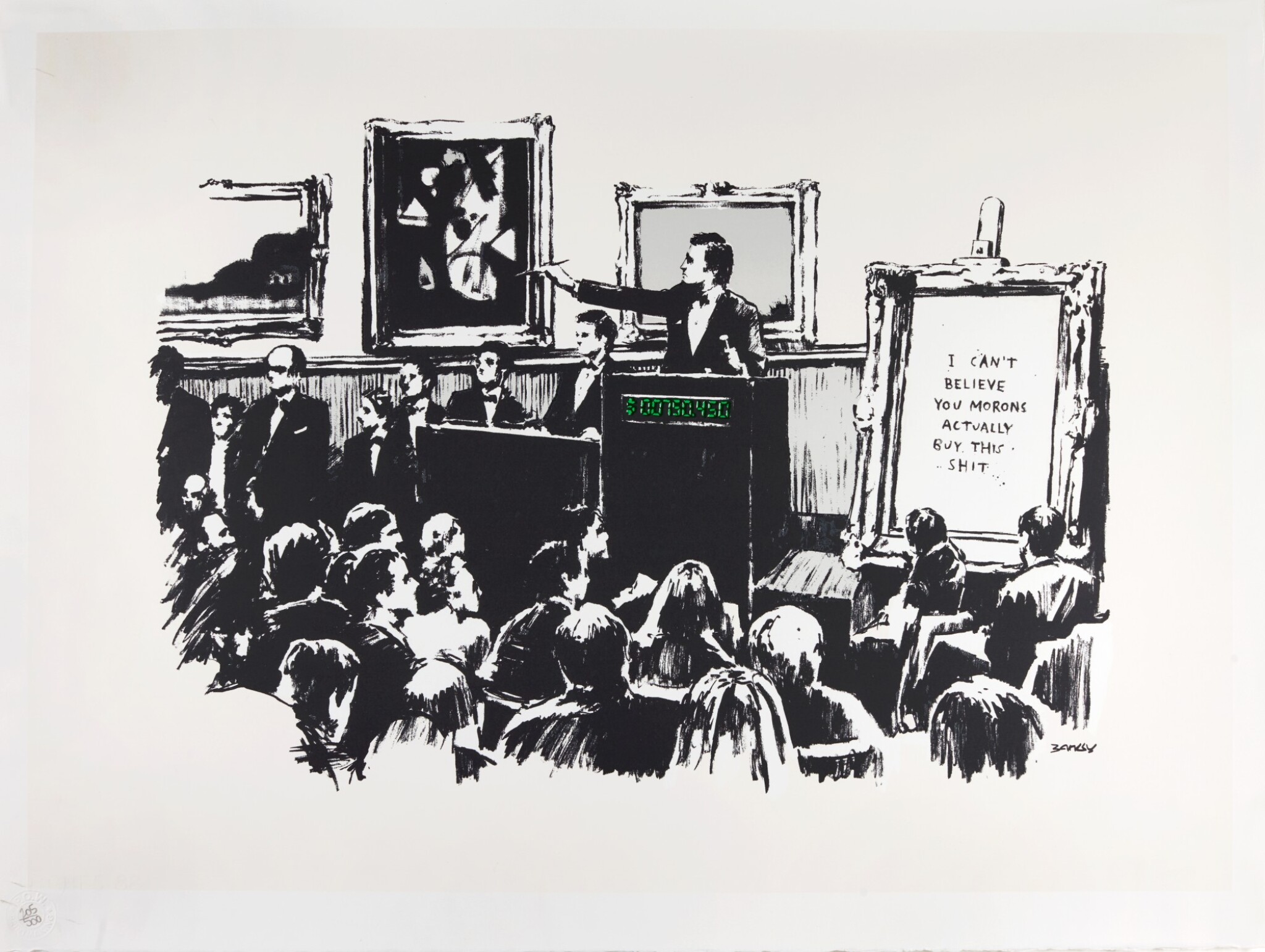
This is, in my interpretation, the scene depicted in Banksy’s 2006 painting Morons. The anonymous British street artist created this satirical piece shortly after the sales of multiple of his works at Sotheby’s auction house in London, doubting the perceptive value of art in the organized art world. But it was far from over. In early 2021, the mocking was brought to a whole new level by the cryptocurrency group Injective Protocol, who purchased and brought Morons to a hidden location in Brooklyn, setting it on fire in front of a camera. According to Nick Reilly’s report of “Original Banksy artwork burned by cryptocurrency group and sold, under the account BurntBanksy, as NFT for $382,000”, the digital image of this once $95,000 piece was sold more than four times than did itself.
I can’t believe a moron actually bought this shit, and at such a premium price.
Despite the absurdity, this is not an one of thing. Following disrupting crypto-art events like this, NFT, cryptocurrency, and digital art became buzzwords among millennials and Gen Zs. Today, we even coined the term Crypto-Art Movement for it. What even are NFTs and cryptos? Are they really worth as much as they do? And more importantly, what’s lurking within our perception of art’s monetary value, or value in general?
During the NFT gold rush in 2021, the vast majority’s understanding of NFT (Non-Fungible Tokens) was tied firmly with the medium of generative sequential pop comic figures, due to the influences of figure collections such as the Bored Apes Yacht Club and CryptoPunks. However, unlike how most people might have defined it, NFT isn’t an art category; a more precise term would be “Crypto Art”. In Brett Crawford and Lutie Rodriguez’s report NFT Art Marketplace: Trends and Considerations, Crypto art is defined as “a digital artwork published directly onto a blockchain in the form of a non-fungible token (NFT). All crypto art exists in the form of NFTs, but not all NFTs are crypto art”. Besides being apes in stylish jumpers, NFTs can also be game assets, virtual lands, or other forms of collectibles. And for those wondering, a blockchain is a digital list of transaction records called blocks. Each block is encrypted and verified by a network of computers so a system cannot jump in and fake a transaction. This is the foundation of cryptocurrencies and the decentralized-finance (DeFi) system like Bitcoin and Ethereum we see today, a secured network that ensures everyone can view and download an artwork, but only one individual is the verified owner. And it is all archived by the process of tokenization – making a recognizable digital presentation or certificate of a digital asset.
This may sound confusing. Perhaps, what may offer a more explicit example of non-fungible tokens as digital certificates is the first NFT in history – colored coins. According to Crypto Dukedom’s book The NFT Revolution 2022, colored coins were invented to enable the blockchain network to have reference to real world objects, making them indivisible and barely exchangeable, differentiating them from fungible tokens like Bitcoin or Ethereum. But what’s more intuitive is the analogy in its name “colored coins”. Picture this scenario you may have done as a kid: you take a one dollar bill and doodle a hat on George Washington’s portrait. Now, the dollar bill still has the same serial number as before, but it’s no longer interchanged like a regular dollar, and it is no longer worth just one dollar. This is how the concept of NFT can be narrowly understood – a doodle on actual money. Digital artists took virtual bank notes, sketched ape figures and digital real-estates on them, and sold them at exceptionally premium prices. But if so, what is the value of it in this sense? In a market of 360000 active NFT wallets (according to a February 2023 report by Rebekah Carter on BanklessTimes), what are we actually buying? As thousands of NFT transactions are being made on platforms like OpenSea and Blur, are we attracted to the bill itself that grows in value, or the artistic certificate’s associated with the bill?

But there’s one thing that’s certain, however: the digital certificate is what differentiates the value of the same nerdly looking blocks on the chain. From the first-to-market collections in the NFT craze like Larva Labs’ CryptoPunks series, the internet’s first impression of crypto art was set to the business model of selling sequential generative pop figures, which adroitly incorporated the property of rarity. In Purushottam Mathur’s 1991 article “The Role of Scarcity Value and Market Price”, the term “scarcity value” is coined as an increase in relative price of the product led by a want of supply, which explains why the prices of many goods like rare stamps or antiques are independent from their cost of production, but reflect the scarcity of the product itself. Indeed, from this small snippet of Econ 101 in this art essay, the value of some punks begins to make sense to us. From Larva Labs’ website, these pixelated punks are divided into categories such as male, female, zombie, or alien, and attributes like cigarette, headband, shades, and frowning. For instance, last sold at 2000 Ethereum (around $6.63M) CryptoPunk #8857 is a zombie with wildly uncombed hair and 3D goggles. However, CryptoPunk #7022 a female punk with the same attributes was sold at only 0.09 Ethereum, about merely 56 dollars. But the power of rarity is far from over, currently at the top of the sales, CryptoPunk #8522, one of the only nine alien punks that has a diamond blue skin, was sold at around 8000 Ethereum ($23.7M).
This is a gold rush, but one taking place at a candy store where everyone’s rushing in to get the chocolate with the shiniest wrapper, at the price of a Manhattan penthouse. But why? In Patrick Hassan’s 2017 journal article “Does Rarity Confer Value? Nietzsche on the exceptional individual”, the author defended Friedrich Nietzsche’s debate of value in his book Beyond Good and Evil – “rarity matters for its own sake”. More specifically, people tend to believe that the value of particular commodities, like a pound of platinum or copper, increases as they become rarer. And the reason why the scarcity is so tied up with their perceived value is that “great and fine things can never be common properties”; as our perception of great is relative, when everything is great, the greater becomes the new great. Hence, arguably, anything that’s common or widespread is for this very reason vulgar.
But, in the case of the crypto art market, this rarity is artificial, bound to manipulate buyer’s perception of value. In that sense, anything can be rare, hence anything can be valuable. Ironically, but paradoxically, “having zero attributes” is an attribute only eight punks have, and people are paying for that. When everyone has a hat or pipe as part of their identity, the bald headed and bare faced, the ordinary of the ordinaries, are the most unique of the uniques, and their thing is having nothing. And it is the same case when gamers pay thousands for a ultra-super-super rare rifle skins, when users buy UID with fewer digits or short social media handles (like how I value my custom email address of “r.han”, which means I’m the only R. Han in NYU that can use that address), and, of course, when gents in tuxes and ladies in gowns bid for the ownership of “I can’t believe you morons actually buy this shit”; we are all “rareophiles”. However, it’s still unclear whether Nietzsche views rarity as a virtue of the valuableness or indicator of it.
This is a large egg or chicken question for sure, but we can try to work out an answer in the scope of NFTs and crypto art. In March 2021, when everyone was kept inside during the covid lockdown, some guy in Brooklyn came up with a stinky idea. According to Hannah Frishberg’s article “NYC man sells fart for $85, cashing in on NFT craze” on the New York Post, Alex Ramírez-Mallis, a film director and now a NFT “fartist”, began selling a year’s worth of audio clips of his and friends’ farts, from a year long quarantine activity on their WhatsApp group chat. The highest bid to his farts was at $183, at the time the article was written. What resonated more than his farts were his statements against the NFT gold rush: “The NFT craze is absurd – this idea of putting a value on something inherently intangible. These NFTs aren’t even farts, they’re just digital alphanumeric strings representing ownership”.
It’s hard to speculate why people bought his fart for prices of a designer brand perfume, but the rarity of making fart NFTs is what differentiate those “fartworks” from other crypto art pieces. Hence, inherited from such scarcity is our recognition of it being creative; in the end, there are no two farts that sound the same. Right?
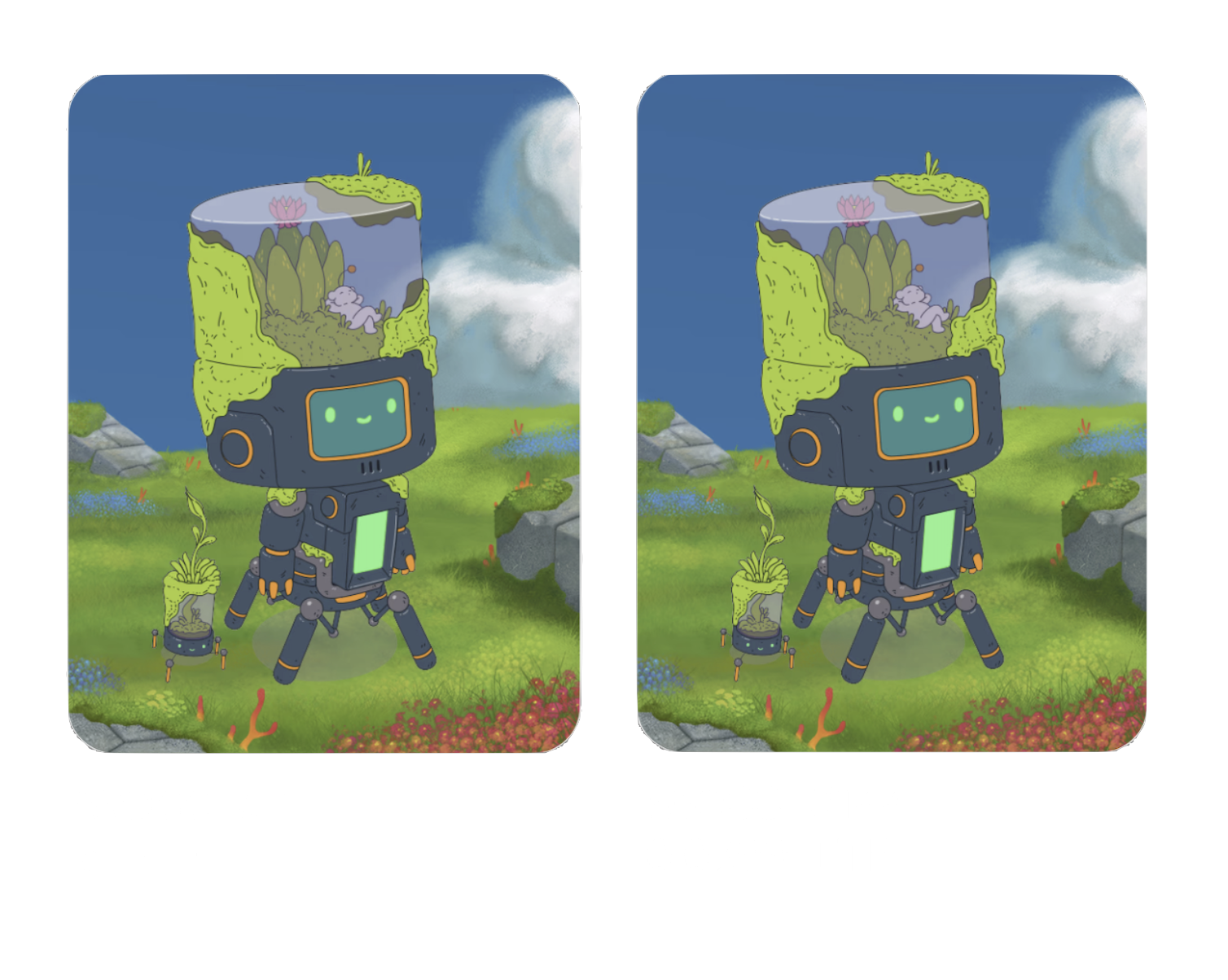
Not entirely. Rarity isn’t alway the determining factor of our perception of value. After we dig deeper into the crypto art market, NFT principles of non-divisible and non-duplicatable began to wobble. From a collection namedFuture Realities: CarbonPrintShop X Reddit Collectible Avatars, I spotted, technically, two artworks. The one named MOSS #71 is selling at 3 Ethereum (~$5540), while the other, MOSS #144, at 0.0299 (~$55). Looking at the artwork(s) themselves/itself, do you spot any difference? Neither can I.
It’s hard to believe that a moron actually bought this expensive shit, while an exactly identical shit cost about only 0.997% of its price. From a technical standpoint, the moment the two NFTs are created, they are considered different tokens of different alphanumeric codes but with the same digital representation. It seems that it isn’t just properties of the digital artwork that’s influencing our perception, but the tokens too. In this sense, what is the relationship between the two? And what role do the tokens play?
I brought this question to a producer at Ullens Center of Contemporary Art (UCCA) at Beijing, who organized that gallery’s first, the world’s first major, Crypto Art exhibition Virtual Niche: Have You Ever Seen Memes in the Mirror? in UCCA Lab in March 2021. He pointed out: the core of NFTs is consensus – the recognition and verification of ownership across the blockchain network. The artwork is a certificate that proves only the owner’s ownership, regardless how others download and view it. This self-referentiality enabled us to own things in a way we’ve never seen in the physical world. In our “physiverse” that we call home, proofs of ownership can be piles of red-taped paperworks; isn’t it absurd that we even need a piece of paper to prove that we were born? But through blockchain, the object we purchase is the certificate itself. Or, in other words:
I own, therefore I own.
Eager to taste the feeling of ownership of a new era, I took a deep dive into this open sea. In April 2023, I browsed on the NFT trading platform OpenSea, looking for artworks I could afford. In a collection called FRENS by GABE WEIS by the artist TheStoic. The entire collection is composed of different color variations of a painting by a mixed-media artist Gabe Weis. More specifically, the painting depicts a crowd of cubist people, swarming and cuddling together. My eyes landed on token #6465. It has one of the most vibrant color gradings in the collection.
“The floor is at 0.008 Ethereum, do I hear a 0.0081?”
I hesitated a little, and raised the virtual paddle. Instead to keep competing, I jumped the bid by calling out the highest price.
“0.0082 Ethereum (~14.89 USD)!”
“Going once, going twice, sold to the ordinary and low-class kid staring at a computer! Congratulations sir, on your acquisition of this masterpiece.”
And there it is, I bought my first NFT.
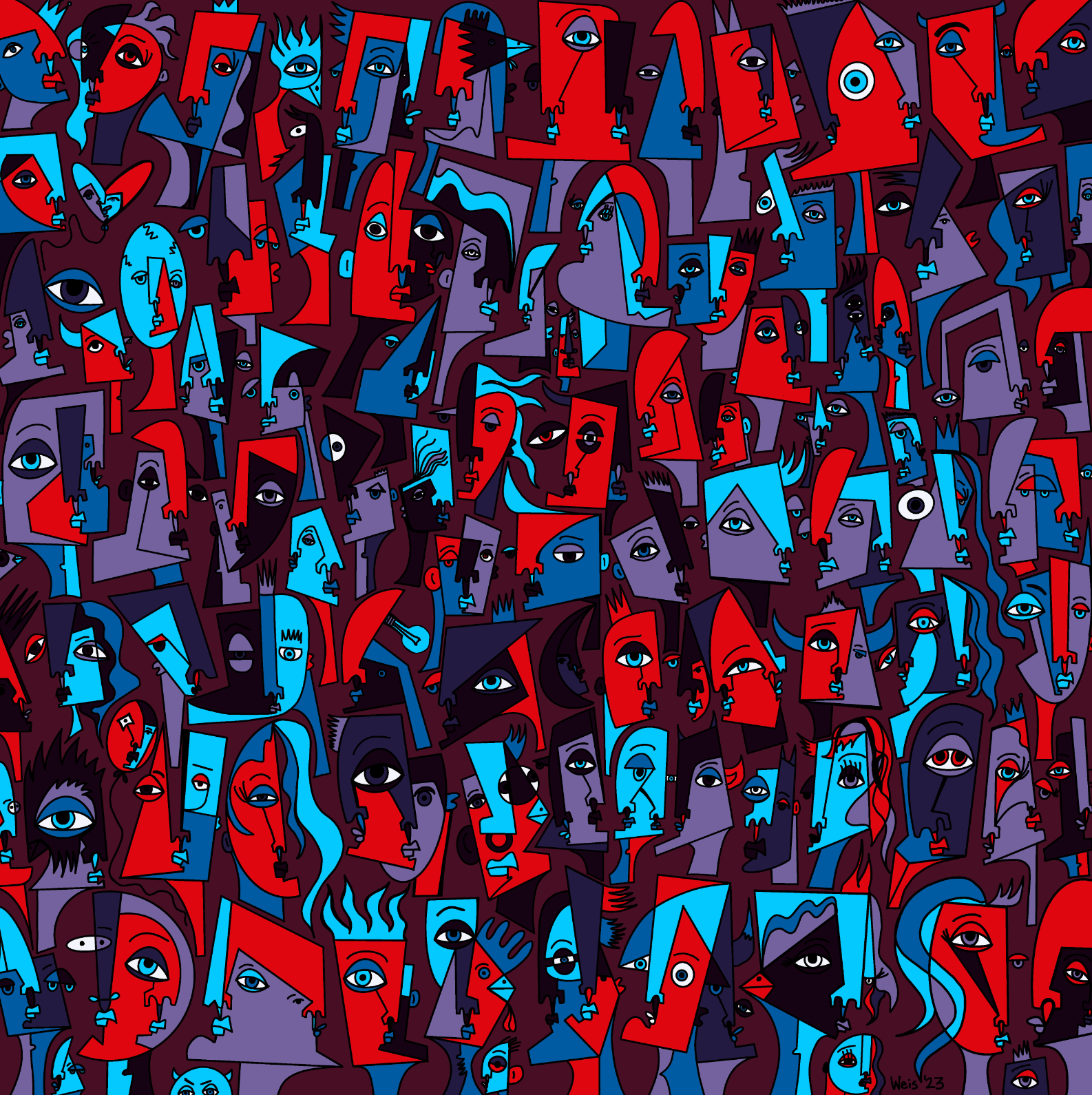
It feels good owning something. After I paid a 0.006009 Ethereum of “gas fee” to the those devices that compute for the blockchain, I’m proudly the official owner of Frens #6465. But when I flexed it around my associates, I got a very unified response:
“I can’t believe you actually bought this shit”
They laughed how they could just download this image from the internet and own a copy of it, use it as desktops or profile pics. Even the fact that I have to cite it to put it in my essay undermines the claim that “I own it”. I felt like a moron. I started to question myself: to what extent is it mine?
At the moment, maybe, not as much as I thought. According to the UCCA producer, during the preparation of the exhibition, the team experienced trouble drafting the Exhibition Loan Agreement, the document that grants the gallery to show the artworks for a period of time, because the consensus of blockchain has no complete legal effectiveness. The ownership, in this sense, is still powerful, but only limited within the crypto community.
It seems like we are drifting away from the answer to the question “why do we value NFTs”. More than half way into this essay about value, I have to make a conclusion that NFTs’ value is, in many ways, fungible. Banksy’s ingenious painting is gone, forever; the punks, the apes, they are not even art, not even fart, they mean nothing in the physical world.
Or, maybe, maybe that’s the whole point of it. Perhaps, we need to look at this from a different angle, from the other side of the physico-digital division.
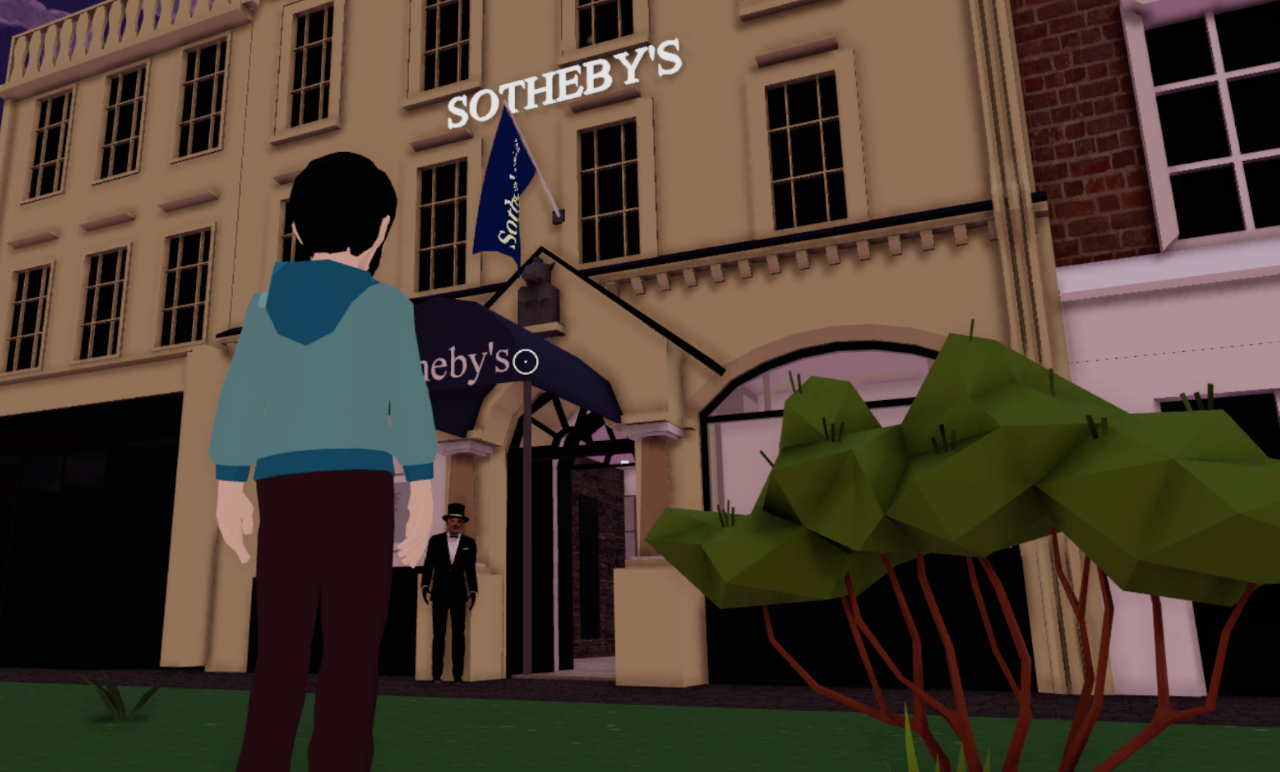
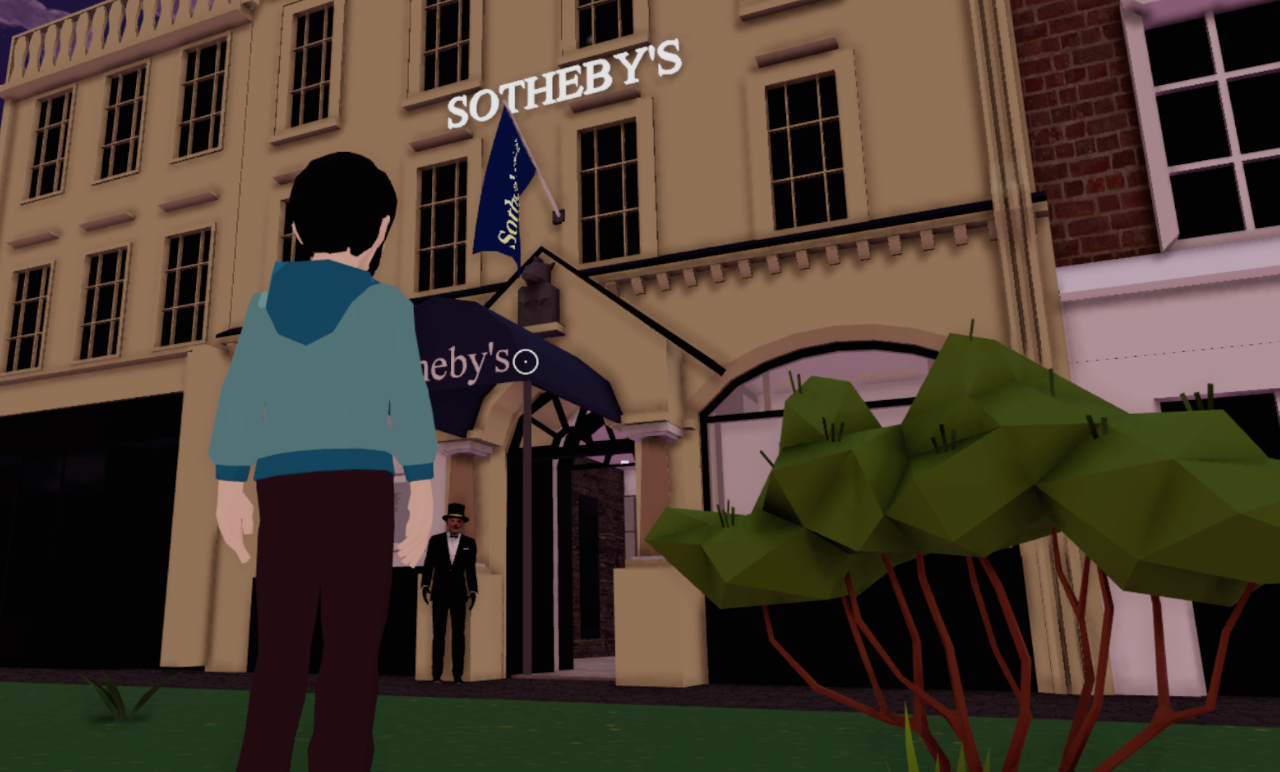
Welcome, to Decentraland, a fully decentralized 3D virtual world, in which land and assets are traded as NFTs. I set up my avatar and connected my crypto wallet; it’s time to take a stroll in Genesis City. Our first stop on this tour is parcel (52, 83) Voltaire Art District, where Sotheby's auction house is located, sounds familiar? This is an exact replica of the Sotheby’s auction house at Bond Street, London, where Banksy’s works were sold in 2006.
According to Yannis Kostarias’s article “The Virtual Sotheby’s Auction House in Decentraland” on Art Verge, a Sotheby’s paved its way to a wider range of blockchain and NFT artists, more and more crypto artworks were brought in to physical and virtual auction houses. However, in November 2021, Sotheby’s sold Banksy’s Trolley Hunters and Love is in the Air (2006) using Ethereum as bidding currency.
“Going once, going twice. Sold!”
The first record in history of using cryptocurrency in real-time auctions of physical art pieces was made. But why? The merits of cryptocurrencies no longer apply when trading physical art pieces; the decentrality, efficiency of transactions, encryptioness and safeness all become valueless. Instead, the painting needs to be shipped, protected by insurances, and paperworked to prove who owns it, which all mean nothing in the digital world.
I can’t believe you encrypted morons actually buy this shit.
Looking through the screens, but this time from the virtual to the physical side, I can’t understand why physical art pieces are worth as much. Perhaps, “why do they buy this shit” was never the proper question to ask, but “why do we see it as ‘shit’?” Now, the origin of this predetermined and biased notion seems apparent – we live in the physical world.
However, for innovators and early adopters, virtual worlds are perhaps the future. Or, in a term that’s more familiar to us – Metaverse, a buzzword that’s no longer buzzing as much. Consequently, to those who have already bought an early bird ticket to the virtual world, physical objects and tangi-currencies are no longer valued; hence, buyers sweeping up the market floor in NFTs sales, digital furnitures, and Genesis City Penthouses are beginning to sound justified. But to physi-dwellers, they’re absurd. The physico-digital divide is a warped looking glass, making individuals on the other side appear funny.
Although we’ve yet to immigrate into a world where alien punks are hanging on our bedroom walls and Brooklyn farts playing gramophones, we are not far away from it. The shift is already happening subtly and intellectually. As platforms like Twitter launched NFT-profile which allows users to display their NFT in a soft hexagon, people are given more opportunities to share interests and flex fancy outfits on avatars, hence fueling the digital fashion. In Patrik Aspers and Frédéric Godart’s 2013 journal article “Sociology of Fashion: Order and Change”, Adam Smith’s claim on philosophical mechanism of fashion from The Theory of Moral Sentiments was quoted: It is the result of an imitation process rooted in “sympathy”, a feeling through which individuals relate to each other. Moreover, fashion, in our lifestyled-based identities, determines who’s in and who’s out.
Indeed, humans have been social animals for ages, and that model hasn’t changed when we are migrating to the cyberworld. The consensus from blockchain isn’t just for verifying ownership, but also recognizing our identity, scanning name passes and determining who gets to crash at a yacht club of bored apes and alien punks and who does not.
The way we value things hasn’t changed. We still worship rarity and demand recognition. It’s just that our identity is becoming more digital. And in the middle of this great migration, it seems to individuals of the opposite party, we are all morons.
The discussion of value has come to an end, but the thunderous sound from the Brooklyn film director still echoes. In the end, even when the token is valued, the artwork is just an avatar of the value. However, when I raised this concern to the UCCA producer, he responded that: “as it is in contemporary art, the idea behind the artwork is intangible, but it’s the most essential; hence, in some sense, the physical composition might not be as indispensable.”
Contemporary digital art is perhaps the low-hanging fruit for tokenization, which transcends the virtual-physical division, becoming the common language of both types of worlds but interpreted differently. When the citizens of the physical world are jeering into the window of a virtual auction house, the “Decentralandians” are also mocking the physical ones.
“Going once, going twice.”
“Sold! To the encrypted moron!”
END OF STORY